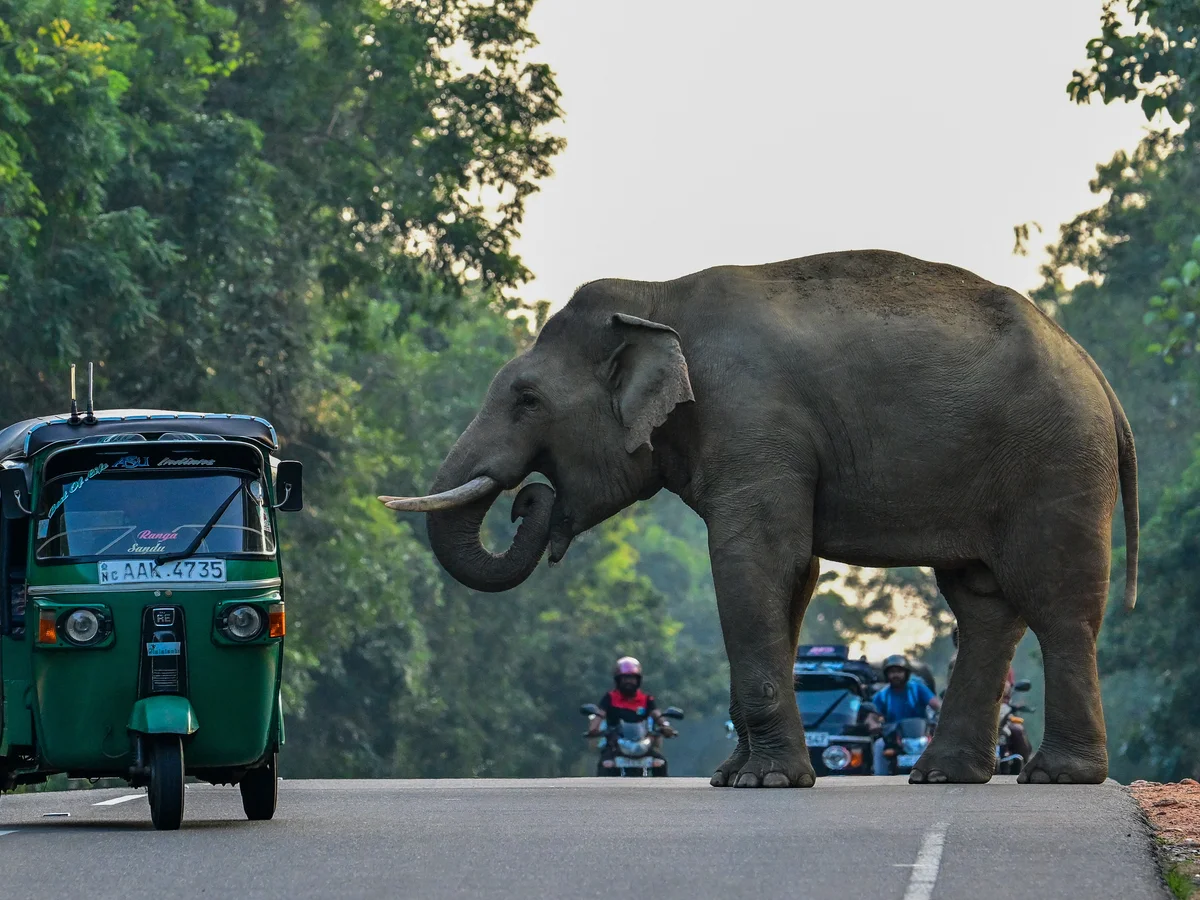
Let’s start with a guy named Dewagiri Mudiyanselage Thilakaratne Bandara. He’s a wildlife officer in Galgamuwa, and his job is basically being the bouncer for a 14-kilometer electric fence along the Siyambalangamuwa reservoir that protects more than 2,000 families. The club is the village. The guys trying to get in weigh about 4 tons and they did not bring ID.
And this isn’t a cute local quirk. Since 2019, Sri Lanka has averaged 138 human deaths a year from elephant encounters, second-highest in the world. Elephants have it worse: an average of 402 dead per year, the highest anywhere. The all-time record came in 2023, with 488 elephant deaths per the Department of Wildlife Conservation. That’s more than one a day. For a whole year.
How elephants die (it’s not old age)
In 2025, Sri Lanka logged 397 elephant deaths: 71 shot, 56 electrocuted, 46 hit by trains, and 20 killed by “hakka patas,”which are explosives hidden in food. Eight more fell into abandoned wells. In February 2025, one train in Minneriya killed six elephants from the same herd. Meanwhile, natural elephant deaths in the country are described as very rare. So if you’re a Sri Lankan elephant, “died peacefully surrounded by family” is not really on the menu.
The decade totals are bleak. From 2015 to 2024, 1,195 people and 3,484 elephants were killed, according to the environment minister. The state also spent about $11.6 million just disposing of elephant carcasses over that stretch, versus roughly $4 million in compensation to attack victims. Read that again. The government spent nearly three times more on cleanup than on the people who got hurt.
The mango incident
Last December, an elephant wandered into Bandara’s backyard to eat mangoes. It attacked him, then his wife, Shirani Rathnayake, when she ran to help. Bandara got a broken leg and dislocated shoulder. Rathnayake was trampled and had her right leg amputated. She now uses a wheelchair.
No joke there. Here’s what Bandara said about the elephant, though, and it’s the most decent thing you’ll read this week: he was hungry because of the activities of us humans. The man lost his old life and still won’t badmouth the elephant. Some of us can’t forgive a guy for taking our parking spot.
Life on elephant time
The village has reorganized itself around the animals. The local school starts 30 minutes after the national 7:30 a.m. start time to dodge early-morning elephants. People leave work early to beat dark. Weddings and funerals get scheduled around herd risk. Neighbors run a WhatsApp group that tracks elephant movements and chase raiders off with yelling and firecrackers.
So somewhere in Sri Lanka there’s a group chat that’s 100% “big one by the tank again.” That’s the most useful group chat in human history. Yours is 400 unread memes and someone’s cousin selling essential oils.
So why is this happening?
Short version: less forest, more elephants. Sri Lanka’s forest cover dropped from about 70% in the 1920s to about 34% today, per World Bank data. Up to 70% of the country’s estimated 7,451 wild elephants live outside protected areas, and the population is up 27% from a decade ago. Elephants now range across 62% of the country’s land.
It’s a math problem where the variables weigh 8,000 pounds.
So what's this all mean?
Elephants pull in tourists for a $4 billion industry, they’re central to Buddhist culture, and killing one is a crime. They’re also getting electrocuted, shot, and hit by trains at a world-leading clip, while the people living next to them plan weddings around a WhatsApp alert. Bandara’s pitch is simple: stop clearing forest and start replanting it. Hard to argue with a guy who earned that opinion the hard way.