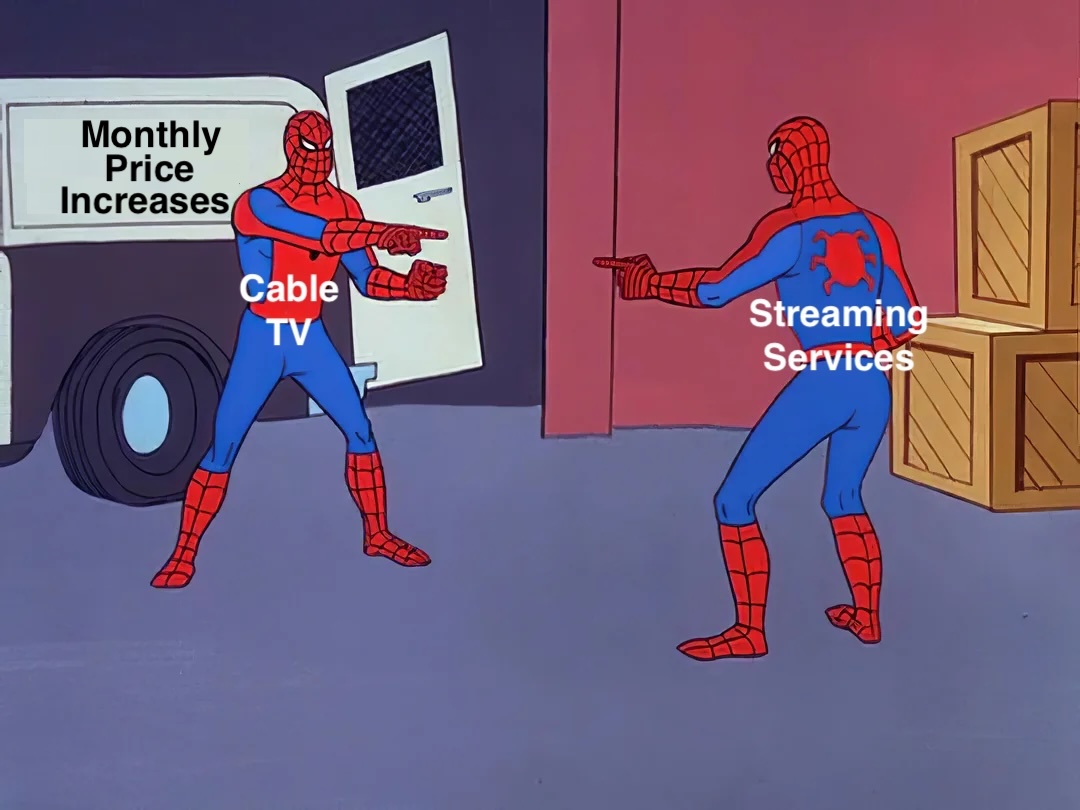
In November 2010, Netflix launched a streaming-only plan for $7.99 a month. The pitch was simple: cancel your cable, pay about $8 bucks, watch whatever you want, and unofficially share it with anyone. We took the deal. It was a great deal. Anything to make those assholes in Cable suffer. And suffer they did, U.S. pay-TV went from a peak of about 100 million subscribers in 2012 to an estimated 55 to 60 million by 2026.
It was a jailbreak. Millions of Americans tunneled out of the Comcast/Spectrum/whatever-your-regional-monopoly-was prison with a spoon, Shawshank-style, crawling through 500 yards of sludge toward freedom.
Then they stood up in the rain, arms outstretched, and a 10 different people handed them 10 different bills and the amount requested in the bill basically went up every 2-3 months.
The Escape Now Costs More Than the Prison
Fortune added up eight major streamers without ads and got $139 a month. For comparison, the average pay-TV bill in 2016 was $103.10. So the thing we fled is cheaper than the thing we fled to. That's like breaking out of prison and discovering that you've broken into another prison that is run by 10 different wardens.
And at least cable was one place. One remote. One bill. One guy named Kevin who'd show up sometime between 8am and never. You didn't need eleven passwords and a six-digit code texted to your phone just to watch a Law & Order rerun.
It's not just the total. It's the speed. According to a Hollywood Reporter analysis, streaming prices rose 11.8% over the past 12 months, peaked at an average 17.7% jump in 2023, while cable and satellite averaged about 3.9% a year. Forrester found the average ad-free streaming price climbed 54% from 2021 to 2025, against roughly 16% inflation.
Cable, the most hated industry in America, raised prices slower than the guys who were supposed to save us from cable. Cable is sitting in a lawn chair right now, sipping a Coors Light, going "Huh."
Every Cable Feature Is Back, Baby
Let's check the list.
Bundles? ✅. Disney's ad-free Disney+ and Hulu bundle costs just 50 cents more than one service alone. That's not a deal. That's a car salesman saying "for fifty cents more, I'll throw in the other car," and you realizing you didn't want either car.
Commercials? ✅, and now you pay for them. Netflix's ad tier launched at $6.99, went to $7.99 in 2025 and $8.99 in 2026. The budget option has its own price hikes. Even the escape hatch has a toll booth. Disney basically doesn't care, it's straight up saying in the fine print that their ad-free tier will have ads.
Mega-mergers? ✅. Earlier this year Paramount outbid Netflix for Warner Bros. Discovery, and Paramount paid Netflix a $2.8 billion breakup fee. Netflix raised prices a month later. Getting dumped, receiving $2.8 billion as a consolation prize, and then asking your subscribers for two more dollars is, legally speaking, a power move.
Channel surfing? ✅, sort of. The Hollywood Reporter describes "streaming cycling": subscribe for a month or two, binge, cancel, hop to the next one. It's channel surfing, except every channel requires a new account, a new password, and your credit card number typed in with your thumbs.
Oh, also. No more sharing your login either.
So How Did This Happen? Meet the Slide Deck.
Here's the turning point. In April 2022, Netflix lost 200,000 subscribers, its first drop in over a decade, and its stock fell 35%, wiping out $54 billion in market value in a single day. Disney, Paramount and Warner Bros. Discovery shares all dropped the same day.
You'd think that subscriber growth was out and profit was in with the constant raising of prices, but no, streaming services are using the same tactics cable companies did; offer discounts to new subscribers for the 1st year and then raise prices on them for the rest of time.
Now listen to how they talk. Variety notes Netflix believes it has "pricing power" over rivals. Warner Bros. Discovery CEO David Zaslav called HBO Max "underpriced". Peacock posted its first-ever quarterly profit in Q2 2026 and celebrated by raising prices. That's like getting your first paycheck and immediately asking your parents to up your allowance.
Somewhere, in a glass conference room, a ex-consultant looked at some numbers and said, "I know how to make this chart go up and to the right." And then proceeded to raise prices and fire a bunch of people. The other out-of-touch ex-consultants in the room clapped. Revenue per user: up. Quarterly earnings: up. Bonuses: up. Nobody even created the 2nd slide of the presentation, which is the most important part of the presentation.
The 2nd slide is the lasting impact to consumers and what happens after their genius plan is in play for 3-4 Quarters. I'm convinced these streamers hired a bunch of ex-consultants from the cable companies, handed them the keys, and said, "Oh ex-consultant whose last chart went up and to the right for 2-3 Quarters, but ended up fucking the cable industry, please do the same to this industry. You know the way."
The Sequel Has Already Been Written
Cable raised prices. Cable made you buy bundles. Cable made you watch ads. Then cable lost 40 to 45 million subscribers. This movie isn't a mystery. We already watched it, on a 32-inch RCA that weighed as much as a refrigerator.
And the audience is heading for the same exit as last time: piracy. Data firm MUSO counted 216 billion visits to piracy sites in 2024, up from 130 billion in 2020. Anti-piracy company Corsearch says frequent price hikes are pushing consumers back to pirate sites, and it's not just broke college kids anymore, it's older viewers and whole households. Your dad, the same man who sat you down in 2001 for a very serious talk about Napster, is on a sketchy streaming site right now, clicking "I am not a robot" eleven times and closing a hundred AI porn pop-ups just to watch the Jets lose.
The warning signs are right there in the data. Deloitte's 2026 survey found 73% of streaming users are frustrated by rising prices, about 40% cancel at least one service a year, and 61% would cancel their favorite if it went up just $5. Five dollars. That's the whole margin. That's a Chipotle side of guac.
Will Prices Ever Go Down?
Short answer: history says don't hold your breath. List prices basically never drop. The rare exceptions are tiny, like when Paramount+ launched in 2021 and priced its ad tier at $4.99, a dollar below old CBS All Access, or temporary promos like HBO Max's limited-time annual discount this summer. The "cheaper" option the industry actually offers is ads, and as we covered, the ads are getting pricier too.
Even Variety concedes the pace of these hikes will have to cool off eventually. But if it stops, it won't be because a CFO woke up feeling generous. It'll be because the churn chart finally goes down and to the right and the guy in the vest has no answer for this because he'll pull up his last chart.
Who are we kidding? The ex-Consultant won't even be at the company anymore because he'll have moved on to the next company he's going to fuck up with the same up-and-to-the-right excel magic (charge more, fire people).
Cable learned this lesson the hard way. Streaming is currently paying $139 a month to learn it again.